This is a strawman argument based on incredulity. Because, due to poor education and understanding, the religious can’t envisage anything other than a dog giving birth to a dog (over an arbitrary number of generations), they extrapolate that assumption forward and backward in time and erroneously arrive at the conclusion that evolution is impossible. It’s also a strawman argument because no scientist is saying that a dog won’t give birth to a dog.
The point is that a dog gives birth to a dog (a pup) that has ever so slightly different characteristics to the parent dogs. In one generation it is not possible for a human observer to see the pup as anything but a dog. However scientists can see differences when they analyse the DNA of both the parent and pup.
And the DNA will show a combination of the characteristics of both parents of the dog, as well as any genetic mutation or variation that has occurred. And such genetic variation as helps the parent to survive (e.g. better eyesight or a bushier coat in a cold climate, or bigger teeth, etc.) will have a greater chance of being passed onto subsequent generations than a lesser version of that dog species because the lesser version may have died before performing as much breeding.
Human beings have used the principles of selection in evolution to great effect when it comes to the dog. Many, many dog varieties today have been selectively bred in a relatively short space of time because humans have found it desirable to do so. However to achieve that, humans have used the underlying mechanism of evolution to their advantage. To achieve the desired breeding of dogs, humans have artificially kept breeding dogs alive, and mated selective pairs, thus accelerating the selective nature of evolution. Many dog breeds today would have no hope of survival in the wild, but with cages and can openers, they don’t need to.
The selective breeding (domestication) of the dog is a process that has occurred over the previous 40,000 years as humans selectively bred them from wolves. See Domestication of the dog (a Wikipedia link) for more details.
The religious will tell you “oh, that’s microevolution; not macroevolution”, however there is nothing fundamentally different between those two concepts – except time and “intent”.
They will also say “oh, that’s nothing but speciation” (a Wikipedia link), however that’s just a label; not an argument. Speciation involves the very same evolutionary process as causes large changes in animals over a very long period of time.
Don’t for one moment believe that humans have invented some sort of new underlying process or mechanism when they selectively breed dogs. All they have done is used the underlying principles of evolution to their advantage. In some ways it’s both monstrous and ingenious – as anyone who has had dealings with the more boisterous pug variety of dog will confirm.
The fact that no one can visually see a pup as being anything fundamentally different to its dog parents is not the point. All scientists will attest that noticeable change in the wild takes a large number of generations.
Well, not even that large as it turns out. One experiment (link to pnas.org) placed hundreds of thousands of fruit flies in an enclosed outdoor environment and then added different species of microbes to the flies’ food. In as little as five generations, changes to the flies’ genome were detected. That outcome cannot be interpreted as anything other than evolution at work.
The reason that changes can take a lot longer in the wild is that the “enclosure” is a lot bigger (the whole world), and therefore there is more competition for mates and food, there are more prey to slow down the “experiment”, and there are more factors that will affect the evolutionary process. If the genome of an animal is being affected across generations, then anything is possible (based on the environment) if enough generations are considered.
And of course, the process of evolution has applied to all creatures, throughout all time on Earth.
Here is a table that presents the key stages in the evolution of human beings (images and links taken from Wikipedia). As you look down the table, notice the slow progression of the organisms in the sample images – from row to row. Also note the changing major characteristics.
| Organism/Animal | Time (millions of years ago) | Group | Major characteristics | Sample image |
| Protocell | 4,300 | Unicellular (Single-cell organisms) | Self-replicating RNA molecules. |  |
| Prokaryote | 4,000 | Unicellular | RNA stabilizes into double helix structure of DNA. |  |
| Cyanobacteria | 3,500 | Unicellular | Obtain biological energy via oxygenic photosynthesis. |  |
| Eukaryote | 2,200 | Unicellular | Organelles (cell structures) and sexual reproduction. |  |
| Choanoflagellate | 1,200 | Unicellular | Microvilli and flagellum (tail for motility). |  |
| Dickinsonia | 800 | Animalia (Multicellular) | Bilaterally symmetric with multiple segments, mouth, eye-spots. |  |
| Urbilaterian | 650 | Animalia | Tube arises as a single-chambered heart. |  |
| Deuterostome | 600 | Animalia | Blastopore (first opening) becomes the anus, with mouth at a different site. |  |
| Platyhelminthes | 550 | Animalia | Flatworm. Bilateral, unsegmented. |  |
| Pikaia | 540 | Chordate (backbones) | Shows prerequisites for vertebrates (early spine), eel like. |  |
| Haikouichthys | 525 | Chordate | Primitive jawless fish. Earliest known vertebrate. Brains, blood, throat, ability to smell. |  |
| Agnatha | 520 | Chordate | Jawless fish with pouch-like gills. Ears, camera eyes, skin layers, two-chamber heart, ability to taste. |  |
| Placodermi | 460 | Chordate | Jaws, scales, teeth, stomachs, spleens, hemoglobin, adaptive immunity. |  |
| Cephalaspis | 430 | Chordate | Heavily armored, used armor as a source of calcium, sensory patches on head shield. |  |
| Coelacanth | 420 | Chordate | Lungs, preliminary ribs and other bones, intracranial joint, rostral organ, external nostrils. |  |
| Panderichthys | 415 | Tetrapod (four legs) | Protolimbs. |  |
| Tiktaalik | 375 | Tetrapod | Believed to be the first animal to walk on land (or in shallow water). |  |
| Acanthostega | 365 | Tetrapod | First vertebrate animal with recognizable limbs. Lacked wrists and had fish-like shoulder. |  |
| Ichthyostega | 360 | Tetrapod | Eyelids, tear glands, stronger bones, complete rib cage, recognizable legs. |  |
| Pederpes | 358 | Tetrapod | Tongue, salivary glands, three-chambered heart, glottis, bladder |  |
| Westlothiana | 338 | Tetrapod | Among the oldest known uncontroversial tetrapod. Not yet an amniote. |  |
| Hylonomus | 330 | Tetrapod | Possible amniote. Keratin, shelled eggs, adrenal glands. |  |
| Phthinosuchus | 300 | Mammal (milk producing) | Early diaphragm, specialized teeth, secondary palate. |  |
| Cynognathus | 260 | Mammal | Warm blood, thicker skin, better lungs, lymphatic system, erect hind limbs. |  |
| Repenomamus | 230 | Mammal | Milk glands, sweat glands, hairy skin, internal penis, four-chamber heart, constant blood temperature. |  |
| Juramaia | 170 | Mammal | Live birth, marsupial pouch, nipples, placenta, external penis, anal and urogenital openings. |  |
| Plesiadapis | 90 | Primate (an order of mammals) | Closely related to primates. Partial left mandible (lower jaw). |  |
| Carpolestes | 65 | Primate | Forward-facing eyes, grasping digits. |  |
| Aegyptopithecus | 50 | Primate | Menstrual cycle, diurnality, paranasal sinuses. Claws became nails. Single pair of mammaries. |  |
| Proconsul | 20 | Primate | Trichomatic vision, larger brain. Lack of a tail. |  |
| Pierolapithecus | 13 | Hominidae (family of primate. great apes) | Flat and widened rib cage, stiff lower spine, flexible wrists, shoulder blades. |  |
| Ouranopithecus | 9 | Hominidae | Perhaps the last common ancestor between humans and the other apes. |  |
| Orrorin | 6 | Hominidae | Likely bipedal but still had grasping feet. Larger brain size. Constructed tools. |  |
| Ardipithecus | 5.7 | Hominidae | Reduced canine teeth in both male and female. Reduced aggression. |  |
| Australopithecus | 4 | Hominidae | Completely bipedal. “Lucy“. | 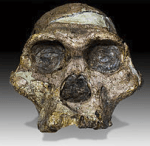 |
| Homo erectus | 2 | Homo (genus of hominidae. contemporary human) | Introduced clothing, fire and the wheel. |  |
| Homo neanderthalensis | 0.3 | Homo | Brain size stabilizes, trunk and limbs elongate. |  |
| Homo sapien | 0.30 | Homo | Human. You! |  |
See also: Human Evolution – From Protocells to People (an external website) for the above presented in a nice wall chart.
There is sometimes a debate whether a certain list of “ten commandments” should be displayed in public places and classrooms. What would actually be of benefit to humanity is if the above table/chart was displayed in those places. That would be progress.
Note that the information in the above table is open to change due to scientific discovery. There is in fact a continuum of information that is represented by the above 38 rows, and of course new fossil discoveries can (and do) refine the entries given above. There is healthy debate about how to classify discovered specimens, especially for the Hominidae family and the Homo genus. For more details, see Human evolution (a Wikipedia link).
Looking at the rows in that table, it is very plausible that the creature in one row changed into the creature in the next row – especially given millions of years. The fossil evidence of that gradual progression is well established, and undeniable. The organism in each row generally inherits the characteristics of the organism in the row before it, however sometimes characteristics are dropped (generally not detailed in the above table, but can be investigated via the links provided).
It’s tempting to just look at the pictures in the above table, however the “Major characteristics” column is extremely illuminating (and worth reading). That column gives the important reason why the above 38 organisms were selected to be in the table. Creationists love to look at pictures and dismiss/ignore the reason why certain entries were made, however the description column is hugely revealing as to the reason for inclusion.
Note that there are 38 rows in the above table however they are not evenly spaced when it comes to Time (in millions of years). For example, the first half of the table represents about 4 billion years and the second half of the table represents about 0.35 billion years. it took a very long time for, what appears to be not very much, change to happen.
Apart from the last few rows, the smallest gap between rows in the table is 2 million years (and the average gap is more like 10-20 million years). Think about that. A lot of generations are possible in 2-20 million years. The entire table depicts a continuum (in 38 rows), however there is a continuum between any two neighboring rows consisting of many millions of generations. Change based on inheritance is looking a lot more likely now, isn’t it?
To deny the information in that table via statements such as “a dog can only give birth to a dog” is ludicrous – and intellectually dishonest. Creationists rely on the incredulity that arises when creatures that are many rows apart are the only ones considered.
So remember, a dog will give birth to a dog … with inherited variation. What will that accumulated variation lead to after a large number of generations? That depends on the cumulative effect of: environment, inheritance and mutation. The table above answers the question (when it comes to humans) and indicates why the statement “a dog can only give birth to a dog” is hopelessly short-sighted, misleading, and dishonest.
See also the page on this website about the mistaken belief that A missing link disproves evolution.